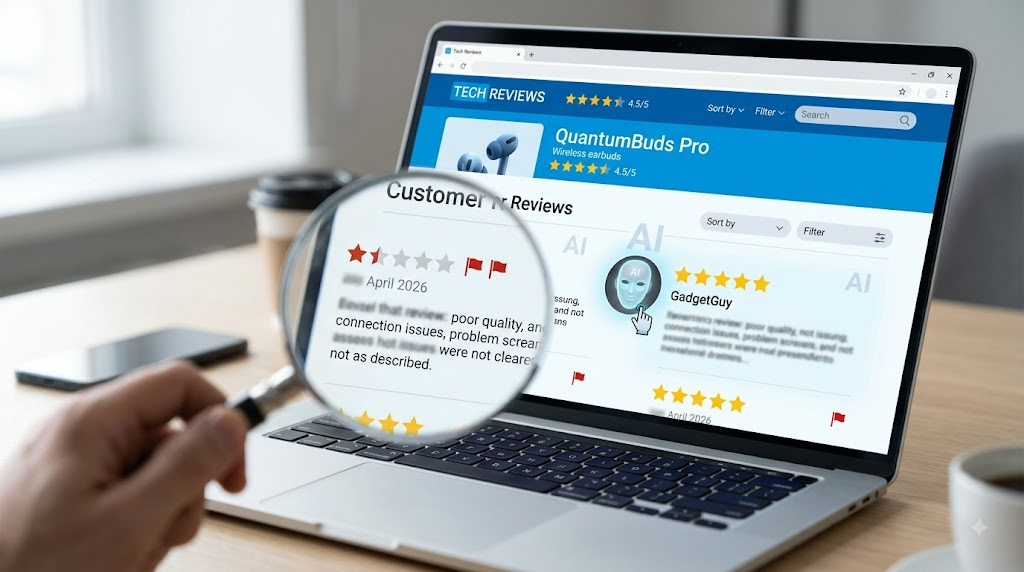
You've read the reviews. The product has 4.8 stars. The store looks flawless. And yet, once it arrives, the quality is terrible, the item never shows up, or the "verified" company turns out to have zero customer support.
The reason is often simpler than you think: you were reading fake reviews.
Research consistently shows that a significant share of online reviews are fabricated. Estimates range from roughly 11–16% on major platforms up to 30% in some independent audits, with AI-generated fakes now making up about 30% of all detected fake reviews. Google alone removed more than 240 million reviews in 2024, and Amazon reported blocking over 250 million suspected fake reviews in a single year. In 2025, fake reviews influenced an estimated $152 billion in global consumer spending.
Consumers feel the impact personally. Around 54% of shoppers will not purchase a product if they discover fake reviews, and 83% will avoid a business entirely after spotting manipulated feedback. Yet most people—roughly 87%—struggle to tell a genuine review from an AI-generated one.
This guide is the RatingFacts Editorial Team’s practical, evidence-based playbook for spotting fake reviews in 2026. We draw on platform transparency reports, FTC rule documentation, academic research on review manipulation, and our own daily experience moderating reviews at RatingFacts. By the end, you’ll know the 15 most reliable red flags—and what to do when you find a suspicious review.
How Big Is the Fake Review Problem in 2026?
Before we list the red flags, it helps to understand the scale. Fake reviews are not a fringe problem; they are a structural feature of modern commerce:
- 14% of all reviews on major consumer platforms are estimated to be fake or incentivized, up from 11% in 2022.
- 30%+ of detected fake reviews are now AI-generated, a sharp jump from under 2% in 2022.
- Google: removed 240+ million reviews in 2024 and blocks millions of profile edits each year.
- Amazon: blocked 250+ million suspected fake reviews in 2023 alone, and continues to invest in graph-based detection.
- Yelp: removed 22.4 million reviews; Trustpilot removed 4.5 million; TripAdvisor rejected or removed 2.7 million in the same period.
- Amazon internal audits suggest up to 16% of marketplace reviews may be fake; high-risk categories (beauty, cheap electronics) can run to 30–42%.
- By contrast, local categories such as restaurants on Yelp and Google show lower fake rates, roughly 6–8%.
The bottom line: fake reviews concentrate where money moves fast—e-commerce, supplements, financial services, travel bookings, and app stores. That is exactly where a bad decision hurts most.
The Legal Backdrop: The FTC Rule on Consumer Reviews and Testimonials
In 2024, the U.S. Federal Trade Commission finalized the Rule on the Use of Consumer Reviews and Testimonials (effective October 21, 2024). It is the first federal rule to directly ban the practices behind fake reviews. Under 16 CFR Part 465, six practices are now explicitly prohibited:
- Fake or false reviews — creating, selling, or buying reviews that misrepresent who wrote them or their experience (explicitly including AI-generated reviews).
- Buying reviews by sentiment — paying for, or incentivizing, reviews that express a specific positive or negative opinion.
- Undisclosed insider reviews — employees, managers, or agents posting reviews without clearly disclosing their relationship to the business.
- Company-controlled review sites — websites that pretend to be independent but are controlled by the business they review.
- Review suppression — using intimidation, groundless legal threats, or false accusations to stop negative reviews.
- Fake social-media influence — buying or selling fake followers, reposts, or views for commercial purposes.
The rule matters for consumers because it gives platforms and regulators stronger tools. Courts can impose civil penalties of up to $51,744 per violation (adjusted for inflation), and the FTC has already sent warning letters to companies and begun enforcement actions—for example, alleging that a home-services firm orchestrated thousands of fake five-star reviews, and settling a supplement company case partly on the basis of undisclosed employee and incentivized reviews.
What this means for you: fake reviews are now legally risky for businesses and actively policed. But enforcement is reactive. Your best defense is learning to spot them yourself.
The 15 Red Flags: How to Spot a Fake Review
No single signal is definitive on its own. A real product launch can create a legitimate burst of reviews, and a quirky brand name is not evidence of fraud. The trick is patterns: when several of these red flags appear together, treat the review—and the business—with suspicion.
Timing & Volume Red Flags
1. Reviews arrive in suspicious bursts
Organic reviews trickle in over time—someone buys, uses the product, and later writes about it. Coordinated campaigns arrive in waves: 30–50 reviews landing in two or three days, then silence for weeks. Look at the date stamps, not just the star average. A recurring pattern of cluster, silence, cluster is a classic sign of a seller periodically boosting a sagging rating.
2. Many reviews posted on the same day
Identical or near-identical review dates are statistically improbable for real customers. It is one of the simplest tells and appears in nearly every detection guide, from Consumer Reports to Fakespot’s methodology.
3. A flood of reviews on brand-new or previously unrated products
When a product you have never heard of suddenly has 500 glowing reviews, ask who could have used it long enough to judge quality. New listings with huge review counts are frequently boosted by review brokers.
Language & Content Red Flags
4. Vague, generic praise with no specifics
Real reviews mention concrete details: “the cable is shorter than I expected,” “the blue is darker than the photos,” “the box arrived dented.” Fake reviews lean on empty superlatives: “Great product, works as expected,” “Very happy, highly recommend.” If a five-star review could have been written without ever touching the product, treat it as suspicious.
5. Repeated phrasing across multiple reviews
Review farms copy-paste from templates. When several reviews share the same unusual sentence structure, the same em-dash-heavy phrasing, or identical wording—like “fast payouts every time” or “unbeatable quality”—they were almost certainly produced together.
6. Over-the-top enthusiasm
Superlatives such as “best thing I ever bought,” “life-changing,” or “absolutely perfect in every way” with no acknowledged trade-offs are a giveaway. Genuine reviewers mention minor drawbacks. Fake reviews rarely do.
7. An AI-sounding, perfectly polished tone
Modern AI reviews read smoothly and grammatically—too smoothly. Multiple reviews with identical structure, uniform optimism, bullet-point pacing, and zero emotional or personal variation are likely machine-generated. In 2026, 46% of consumers suspect a review is fake when it reads like AI wrote it—and they are often right.
8. Discount codes, links, or promotional language
A review that mentions a coupon code, links to a Telegram group, or says “check my profile for the discount” is marketing, not feedback. Same for reviews that are actually ads in disguise.
Reviewer Profile Red Flags
9. New accounts with no history
Click the reviewer’s profile. An account created days before the review, with a generic username (User123, k***o) and no prior review history, is a strong sign of a disposable fake-review account.
10. A review history that doesn’t add up
Real people review products they buy—across categories and star levels. A profile that only ever writes five-star reviews, or reviews a random grab-bag of unrelated products in one burst, does not reflect real behavior.
11. No verified-purchase indicator
On platforms that offer it (Amazon’s “Verified Purchase,” for example), a review without verification is not automatically fake—people may buy elsewhere or receive gifts. But when a large share of glowing reviews on a product are unverified, it’s a red flag.
Rating Distribution Red Flags
12. An unnatural rating curve
Real products produce a spread. Manipulated listings typically show a “J-curve” or “U-shape”: a pile of five-stars, very few two-, three-, or four-stars, and sometimes a cluster of one-stars from competitors. An implausibly clean 89–95% five-star profile with almost nothing in between is suspicious.
13. Perfect or near-perfect scores everywhere
No product satisfies everyone. A 5.0 rating on hundreds of reviews is statistically unusual. As one study notes, conversion actually peaks around 4.9—consumers instinctually distrust a flawless 5.0, and for good reason.
Cross-Platform & Verification Red Flags
14. The reputation contradicts other platforms
If a business has 4.8 stars on its own website or a marketplace but a markedly worse record on independent platforms—Trustpilot, Yelp, Google, BBB, or a dedicated rating site like RatingFacts—the discrepancy itself is evidence. Cross-check before you trust the rosier number.
15. The business filters, hides, or suppresses criticism
If you can’t find a single negative review, the company is either suppressing them (illegal under the FTC rule) or the reviews are curated. Check whether the site shows all reviews or only “selected” ones, and look for negative reviews elsewhere to balance the picture.
How to Verify a Review Before You Trust It
Spotting fakes is one skill; verifying what’s real is another. Use this checklist:
- Read the one- and two-star reviews first. They are the most specific, and their complaints often describe problems that matter to you.
- Look at review dates, not just the average. Recent reviews (73% of consumers only trust reviews written within the last month) are the most relevant.
- Click through to reviewer profiles and check history, age, and consistency.
- Cross-check the business on multiple independent platforms —including a dedicated ratings site such as RatingFacts, where reviewers are verified and moderated.
- Search the web for the brand name + “scam,” “complaint,” or “reddit.” Long-term user communities are hard to fake.
- Use independent detection tools like Fakespot or ReviewMeta for a second opinion on marketplace listings.
- Verify the business itself: domain age, company registration, physical address, working customer service, and clear terms. Fake sellers often have domains registered weeks before going live.
At RatingFacts, we apply exactly these principles at scale: reviewer identity verification, automated anti-fraud algorithms, sentiment analysis to summarize real experiences, and a transparent moderation and dispute process. When you read a rating page on RatingFacts, you are reading moderated, verified feedback—the same kind of evidence we recommend you look for anywhere else.
What to Do When You Find Fake Reviews
- Don’t rely on the business’s own site. Prioritize independent platforms with visible moderation.
- Report it. Most platforms have a “report review” option—use it. On RatingFacts, you can flag any review for our moderation team to investigate.
- File a complaint with the FTC at reportfraud.ftc.gov if you believe you were defrauded or that a business is running a systematic fake-review operation. The FTC now has rule-based authority to pursue these cases.
- Name and share your experience honestly. Balanced negative reviews are valuable to other consumers and cannot be dismissed as “trolls” when they are specific and fair.
- Use your money to reward transparency. Businesses with verifiable, imperfect, dated review histories—and owners who respond to criticism—are the ones worth your trust.
Final Verdict
Fake reviews are widespread, increasingly AI-generated, and expensive for consumers—influencing hundreds of billions of dollars in spending each year. But they are also detectable. The FTC rule gave regulators teeth, platforms have removed hundreds of millions of fakes, and a small set of behavioral tells—review bursts, generic language, new accounts, unnatural rating curves, and cross-platform contradictions—catches the vast majority of manipulation.
Our advice: never judge a business by a single star average. Read recent reviews, read the negatives, verify the reviewer, and cross-check on independent platforms like RatingFacts before you spend a dollar. The extra two minutes are cheap insurance against the $152 billion fake-review economy.
FAQ: Spotting Fake Reviews in 2026
What percentage of online reviews are fake?
Independent studies converge on roughly 11–16% of reviews across major platforms, with some audits placing the figure as high as 30%. High-risk categories like beauty products and cheap electronics can run 30–42% on marketplaces.
How can you tell if a review is AI-generated?
Look for unusually polished, uniformly positive, identically structured text across multiple reviews; generic praise with no specific details; and a lack of personal variation. Studies indicate 46% of consumers can recognize AI-written reviews, and 88% oppose them.
Are fake reviews illegal?
Yes, in the U.S. The FTC’s Rule on the Use of Consumer Reviews and Testimonials (effective October 21, 2024) bans fake and AI-generated reviews, buying reviews by sentiment, undisclosed insider reviews, review suppression, and fake social-media influence. Penalties reach $51,744 per violation.
Why does a product have all 5-star reviews and no negatives?
Either the company suppresses negative reviews (illegal under the FTC rule), or the reviews are curated or fabricated. Genuine products generate a range of ratings; a flawless record is itself a red flag.
Which platforms remove the most fake reviews?
Google removed over 240 million reviews in 2024. Amazon blocks hundreds of millions annually. Other notable figures: Yelp (22.4M removed), Trustpilot (4.5M), and TripAdvisor (2.7M).
How do I verify a business beyond its reviews?
Check domain age and registration, company registration and physical address, working customer support, clear return/refund policies, and its record across multiple independent platforms—including moderated review sites like RatingFacts.
Methodology & Sources
This guide was produced by the RatingFacts Editorial Team. Findings are drawn from platform transparency reports (Google, Amazon, Yelp, Trustpilot, TripAdvisor), the FTC’s final rule text and enforcement announcements, consumer research by BrightLocal, Capital One Shopping, Reputation, and Review42, academic literature on review manipulation, and RatingFacts’ own day-to-day review moderation experience. Statistical figures reflect the most recent publicly available data as of 2026 and may vary by platform and category.
- FTC: Final Rule Banning Fake Reviews and Testimonials
- Federal Register: Trade Regulation Rule on the Use of Consumer Reviews and Testimonials
- FTC: Consumer Reviews and Testimonials Rule Q&A
- BrightLocal: Local Consumer Review Survey
- Capital One Shopping: Online Reviews Statistics
- Review42: Online Reviews Statistics
- Consumer Reports: How to Spot Fake Online Reviews