Booking a cheap flight often surfaces Kiwi.com—sometimes $40 cheaper than the airline’s own site. The platform’s signature trick is "virtual interlining": combining two airlines that don’t share codes, promising that if the first leg is delayed, Kiwi will rebook you on the next connection free. It sounds like a superpower for budget travelers. But is Kiwi.com legit—or are the horror stories real?
Our answer, based on Kiwi.com’s corporate record, consumer-complaint data, platform scores, and the mechanics of how its product actually works: Kiwi.com is a legitimate, well-established flight-booking platform—but its low prices come with real structural risks (self-transfers, split tickets, non-refundable fare rules) that travelers must understand before they book.
This is the RatingFacts Editorial Team’s 2026 verification of Kiwi.com. We scored it the same way we score every company on our platform: ownership and registration, payment security, consumer-complaint patterns, review-platform scores, regulatory history, and the real experience of buyers.
What Is Kiwi.com?
Kiwi.com is a flight-booking platform founded in 2012 in Brno, Czech Republic, by Oliver Dlouhý and Jozef Dvorský. It operates in more than 100 countries and specializes in booking flights, buses, and trains—including combinations of non-partnered airlines into a single itinerary under its Kiwi Guarantee.
Key facts:
- Corporate identity: registered as Kiwi.com s.r.o., headquartered in Brno (Czech Republic), with a U.S. presence (Kiwi.com, Inc., 1221 Brickell Ave STE 1115, Miami, FL 33131; phone (202) 844-4159).
- Scale: tens of millions of searches annually; one of the largest flight-metasearch and booking platforms in Europe.
- Payments: full card infrastructure, PayPal, and local payment methods—so chargebacks function normally if a booking goes wrong.
- Core product: the Kiwi Guarantee covers connection protection (free rebooking if you miss a connection), booking protection, and refunds for canceled legs in specific circumstances.
Kiwi.com is not a fly-by-night aggregator. The company is real, established, and processes legitimate payments. That is why we do not label Kiwi.com a scam in the strict sense. But “legit” and “low-risk” are different things—and the complaint data tells a more complicated story.
How Kiwi.com’s Model Works (and Where the Risk Comes From)
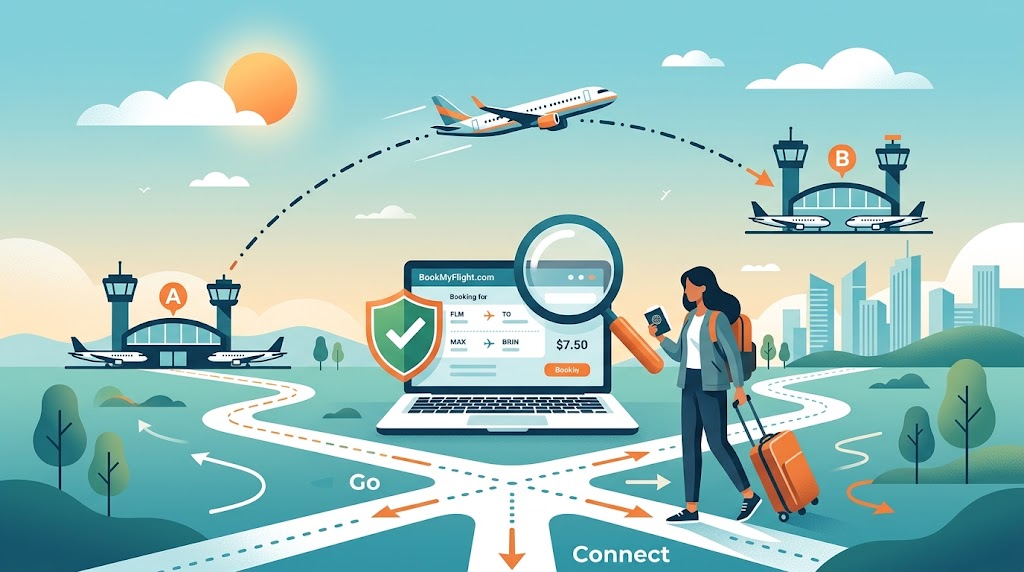
The reason Kiwi.com can undercut airlines is that it stitches together flights from airlines that have no agreement with each other. This is called self-transfer or virtual interlining. The tradeoffs are structural, not accidental:
- Separate tickets. Each leg is a distinct booking. Airlines do not check bags through to the final destination—you collect and re-check your luggage between flights.
- No airline liability for missed connections. A traditional connecting ticket is the airline’s responsibility if the first flight is late. With Kiwi.com, protection comes only from the Kiwi Guarantee—which is why Kiwi’s own customer-service handling becomes the single biggest risk factor.
- Minimum-connection-time traps. Kiwi allows very short layovers to keep prices low; these can be tighter than the airlines’ own minimums, and if a connection is missed and rebooking is slow, travelers can be stranded.
- Changes and cancellations are expensive. Many legs are booked on non-refundable, no-change fare classes. If you need to change plans, you’re often stuck with vouchers or fees.
None of this makes Kiwi.com a scam. It makes it a product where the user bears the connection risk—which is exactly where the complaints concentrate.
What the Review Platforms Say
Cross-platform data shows a split personality: strong app-store ratings, weak complaint records.
- Trustpilot: Kiwi.com’s TrustScore hovers around 4.4 out of 5 (from 30,000+ reviews), with roughly 70% of reviewers giving 5 stars—but the 1-star tail is concentrated in the exact risk scenarios above (missed connections, refund denials, slow rebooking).
- Better Business Bureau (BBB): Kiwi.com, Inc. is not BBB-accredited but carries a BBB rating of A+. BBB complaints include a notable cluster alleging non-receipt of refunds for COVID-era canceled trips—consumers reported that airlines refunded money to Kiwi.com that was never forwarded to them.
- App stores: Google Play and Apple App Store ratings are strong (typically 4.6–4.8) because the search and booking UX is genuinely good.
- RatingFacts: Kiwi.com currently scores 3.6 out of 5 from 140 verified reviews on our platform—reflecting a buyer experience that is fine when flights operate as scheduled and stressful when they don’t.
The pattern is consistent: people whose trips run normally love the savings; people whose trips hit delays, cancellations, or airline insolvency often describe painful, slow support. The single biggest driver of negative feedback is the gap between Kiwi’s automation and the reality of airline disruption.
The Regulatory and Complaint Record
Kiwi.com is a regulated travel seller in the EU, where it holds the certifications required to sell air travel legally:
- EU travel licensing: registered and bonded under Czech law; participates in consumer-travel protection frameworks for package-like products where applicable.
- COVID-era refund complaints (BBB): consumers alleged airlines paid refunds to Kiwi.com that Kiwi did not forward. In 2020–2021 Kiwi.com changed its refund policy to favor travel credit and defended the practice in court; several European consumer bodies challenged these terms.
- Chargeback friction: card-network disputes over canceled flights are a recurring theme—meaning dispute resolution, not fraud, is the dominant issue.
These are disputes over terms and refund speed, not evidence of a fraud operation. But they matter: if you book a complicated multi-airline itinerary, your refund experience depends on Kiwi.com’s own policies—not the airlines’.
What Real Customers Complain About Most
BBB and Trustpilot complaint data converge on five recurring problems:
- Refund denials or refunds issued as credit. The #1 theme—especially for cancellations, where travelers expected cash back and were offered vouchers or partial refunds minus fees.
- Slow rebooking after missed connections. When a delay triggers the Kiwi Guarantee, getting rebooked can take hours through chat, while airlines rebook their own passengers in minutes.
- Baggage self-transfer confusion. Travelers unaware that bags must be collected and re-checked miss their next flight through no fault of their own.
- Airline-name mismatch. Some complaints describe receiving itineraries with legs on airlines they didn’t expect—or split-PNR situations where the airline can’t see the full trip.
- Customer-service reachability. Kiwi.com is heavily automated; reaching a human during a disruption is the most-cited frustration.
None of these make Kiwi.com a fraud. They make it a platform where you must understand the product’s terms before booking—especially for itineraries with tight or self-transfer connections.
Kiwi.com-Related Scams (Not the Same as "Kiwi.com Is a Scam")
Separate from Kiwi.com itself, scammers exploit the Kiwi name. Watch for these:
- Fake Kiwi.com refund emails. Phishing messages claiming "your refund is pending" that redirect to fake login pages to harvest card details. Kiwi.com never asks for your card number by email.
- Impersonated customer-service reps on social media and text, offering to "expedite your refund" for a fee.
- Lookalike booking sites. Cloned Kiwi.com pages advertising unbelievably cheap fares; bookings vanish and cards get charged twice.
If you are unsure whether a site is the real Kiwi.com, check the domain (kiwi.com), look for the padlock, and verify the company’s record on a ratings platform like RatingFacts before entering payment details.
Pros and Cons
| Pros | Cons |
|---|---|
| Legitimate, established company (founded 2012, EU-licensed) | Self-transfer itineraries shift connection risk to you |
| Genuinely cheaper fares via virtual interlining | Refunds can be issued as credit, not cash, on cancellations |
| Kiwi Guarantee covers missed-connection rebooking | Slow rebooking via chat during real disruptions |
| Secure payments (cards, PayPal) with normal chargebacks | No airline liability for missed connections (separate tickets) |
| Strong app-store and Trustpilot ratings (good UX) | BBB complaint cluster over COVID-era refunds not forwarded |
| Rated 3.6/5 by 140 verified reviewers on RatingFacts | Customer service is heavily automated |
RatingFacts Verdict: Legit, But Buy the Right Kind of Ticket
Kiwi.com is not a scam. It is a legitimate, licensed flight-booking platform that has served tens of millions of travelers since 2012 and processes payments securely. The “scam” framing comes from a specific, structural reality: virtual interlining offloads connection risk to you, and when flights are disrupted, Kiwi’s automation can leave you waiting for rebooking or fighting for cash refunds.
Our advice:
- Use Kiwi.com for simple, single-airline, or generous-layover bookings—that’s where it’s safest and cheapest.
- Avoid ultra-tight self-transfer connections unless you are prepared to handle rebooking yourself if things go wrong.
- Never book checked bags through on a self-transfer without planning to collect and re-check them.
- Pay with a credit card so a chargeback is available if a refund dispute stalls.
- Read the fare rules on every leg—non-refundable, no-change fares are common.
- Prefer airlines’ own sites for complex or time-critical trips.
If you need certainty—one airline, bag-checked end-to-end, airline-managed connections—buy directly from the airline. If you want the savings and understand the tradeoffs, Kiwi.com is legitimate—just book smart. On RatingFacts, you can see how real travelers rate Kiwi.com alongside hundreds of other booking sites—verified, moderated, and updated.
Frequently Asked Questions
Is Kiwi.com legit or a scam?
Kiwi.com is a legitimate, EU-licensed flight-booking platform founded in 2012. It is not a scam, but its self-transfer model shifts connection risk to the traveler, and refund handling—especially on cancellations—is the most common source of complaints.
Is it safe to book flights on Kiwi.com?
Generally yes for straightforward bookings. Payments are processed securely, and the Kiwi Guarantee provides rebooking protection for missed connections. The main risks are tight self-transfer layovers, separate tickets with no airline liability, and refunds issued as credit rather than cash.
Why is Kiwi.com cheaper than the airline?
Because it combines flights from non-partnered airlines (virtual interlining) into one itinerary. This creates competition airlines don’t otherwise offer—but it means the airlines themselves have no connection agreement, and you carry the risk if a leg is late.
Does Kiwi.com refund money for canceled flights?
Often yes, but frequently as travel credit or a partial refund after fees. The most common complaints involve cash refunds being denied or replaced with vouchers—especially for airline-initiated cancellations. A credit-card chargeback is the backstop.
What is Kiwi.com’s BBB rating?
Kiwi.com, Inc. is not BBB-accredited but has a BBB rating of A+. BBB complaints include a notable cluster alleging COVID-era airline refunds were paid to Kiwi.com but not forwarded to customers.
Is Kiwi.com a self-transfer platform?
Yes—it specializes in self-transfer itineraries where you hold separate tickets and must re-check baggage between flights. The Kiwi Guarantee covers rebooking if a connection is missed due to a delay.
What is Kiwi.com’s RatingFacts score?
Kiwi.com scores 3.6 out of 5 from 140 verified reviews on RatingFacts, reflecting good day-to-day booking experiences with real friction during disruptions and refund disputes.
Methodology & Sources
This review was produced by the RatingFacts Editorial Team (author: Tom O’Reilly, Travel & Hospitality Writer). Findings are drawn from Kiwi.com’s corporate disclosures and terms, Trustpilot and Better Business Bureau review and complaint data (as of 2026), EU travel-seller licensing records, consumer-protection reporting on COVID-era refund disputes, and 140 verified reviews collected on RatingFacts. Scores and complaint counts change over time and vary by platform and market; treat them as directional evidence rather than absolutes.