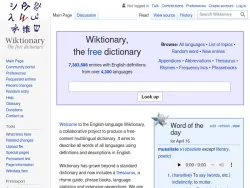
Overview of Wiktionary
Wiktionary is a collaborative, multilingual, web-based project to create a free-content dictionary for every word in every language. It operates under the umbrella of the Wikimedia Foundation, the same non-profit organization that oversees Wikipedia. The primary goal of Wiktionary is to describe all words of all languages using definitions and descriptions in English, though its multilingual nature means entries for non-English words are also extensively developed. It serves as both a lexical resource and a thesaurus, aiming to be a comprehensive, freely accessible reference for linguists, students, translators, and casual language enthusiasts worldwide.
Core Structure and Content
The website is organized into individual entries for each word or phrase. Each entry follows a detailed, structured format. A standard entry typically includes:
- Etymology:The historical origin and development of the word.
- Pronunciation:Guides using the International Phonetic Alphabet (IPA) and sometimes audio recordings.
- Part of Speech:Classification (e.g., noun, verb, adjective).
- Definitions:Numbered meanings, often with example sentences or quotations.
- Synonyms and Antonyms:Lists of words with similar and opposite meanings.
- Related Terms:Hypernyms, hyponyms, and other lexically connected words.
- Translations:How the word is translated into numerous other languages.
- Inflection Tables:For languages with complex morphology, showing conjugations or declensions.
Key Principles and Community
Like its sister project Wikipedia, Wiktionary is built on a wiki model, meaning its content is created, edited, and maintained by a global community of volunteer contributors. It adheres to core policies of verifiability, neutral point of view, and the exclusion of original research. A significant principle is its focus on being a dictionary rather than an encyclopedia; entries concentrate on linguistic data rather than extensive factual information about the concepts the words represent. The community actively discusses formatting standards, inclusion criteria for new words, and the handling of etymology to ensure consistency and reliability across millions of entries.
Multilingual Scope and Special Features
While the English Wiktionary (en.wiktionary.org) uses English as its metalanguage for definitions, it hosts entries for words from countless languages. Separate, independent Wiktionary editions exist in many other languages (e.g., French, German, Chinese), each describing words in their respective language. Notable features include extensive coverage of archaic, dialectal, and slang terms, detailed information about idiomatic expressions and proverbs, and appendices on topics like common misspellings or lists of words in specific categories. Its free license (Creative Commons Attribution-ShareAlike) allows its data to be reused in various applications, contributing to other linguistic databases and tools.
Utility and Audience
Wiktionary is an invaluable resource for anyone engaged with language. Its depth makes it useful for academic reference, while its accessibility supports everyday lookups. Writers use it to find precise definitions or synonyms, language learners utilize its pronunciation guides and translations, and developers can access its structured data for computational linguistics projects. By combining the depth of a traditional dictionary with the breadth, immediacy, and collaborative spirit of an open-web project, Wiktionary stands as a unique and continually evolving pillar of the free knowledge movement.